Strategy · AI Search
When the First Visitor Is a Machine: Inside Sitecore's Scrunch Bet
The buyer already decided before they reached your site. A $225 million acquisition just put a price on doing something about it.
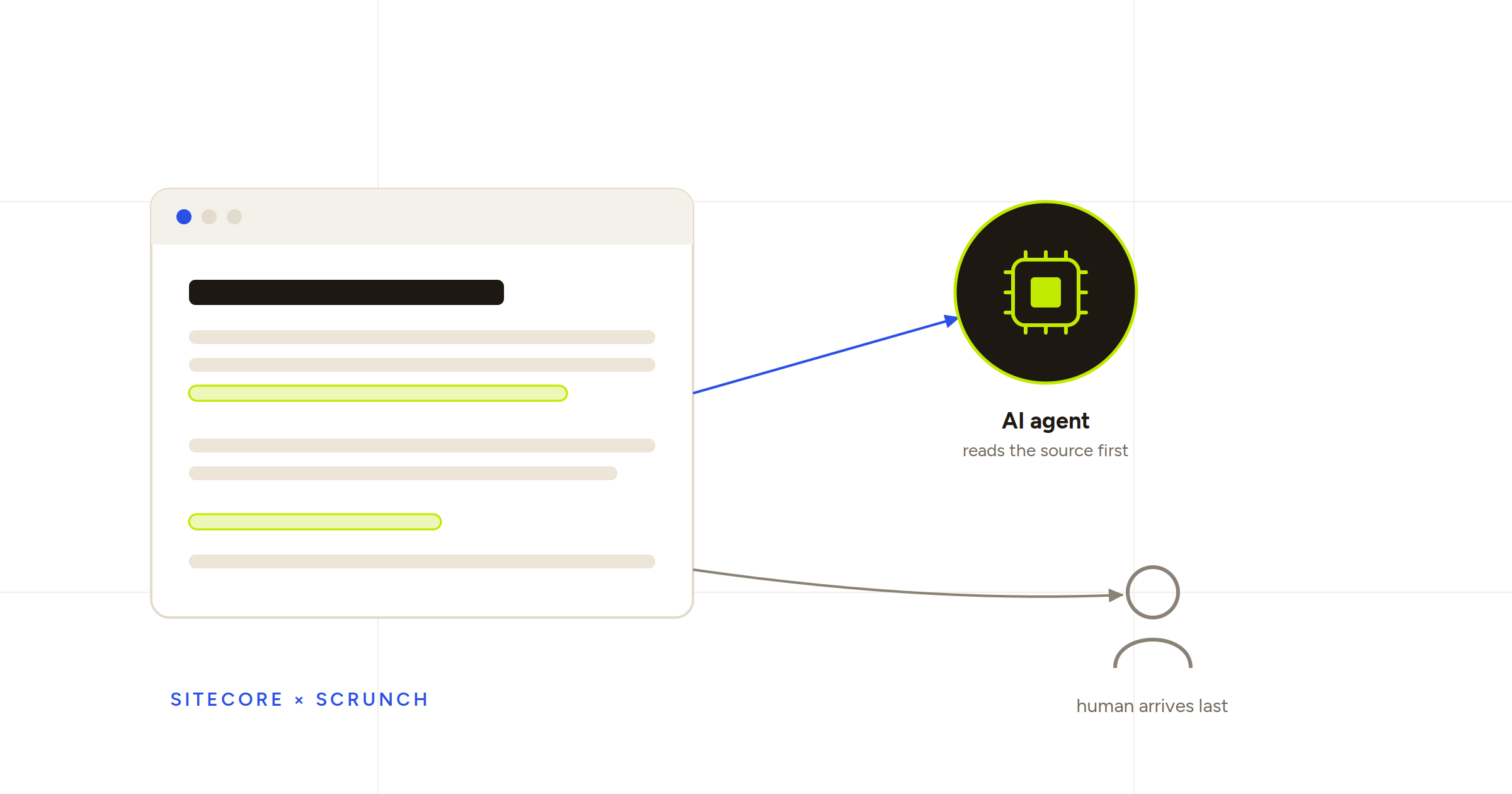
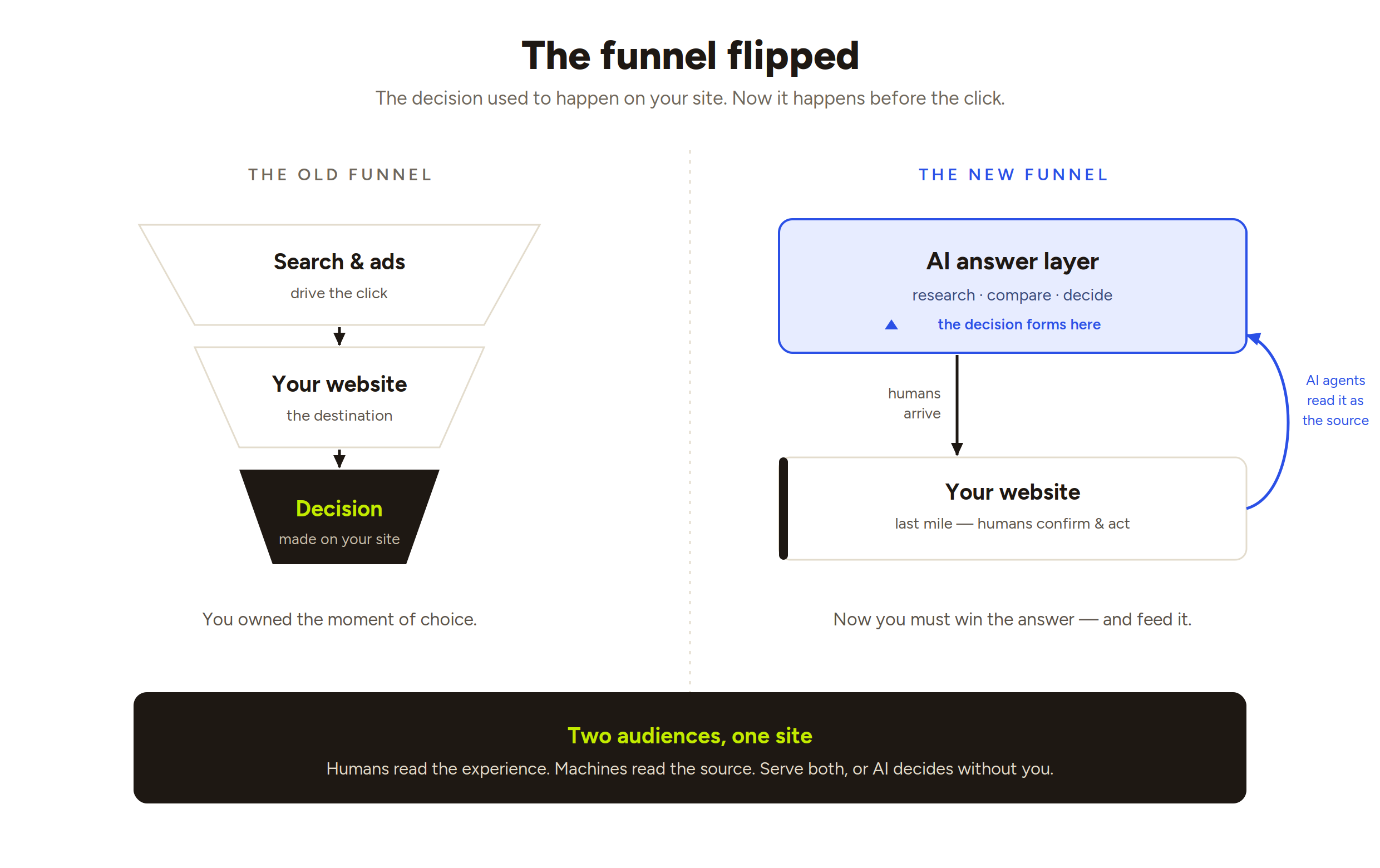
For thirty years, digital marketing ran on one assumption: win the click, then do the convincing. That assumption just broke. By the time a prospective buyer lands on your website today, an AI assistant has often already assembled their shortlist, named your competitors, and formed an opinion of you—one you had no hand in shaping. The click is no longer the opening of a conversation. It is the tail end of one you were never invited to.
That is the backdrop for Sitecore's June 3, 2026 acquisition of Scrunch, an AI-search visibility platform, in a deal Bloomberg reported at roughly $225 million. The number matters as much as the move. It puts a public price tag on answer engine optimization (AEO)—a category marketers spent the previous year arguing was either the future of demand or a passing dashboard fad.
01 — The dealWhat Sitecore actually bought
Scrunch does two distinct things. The first is visibility: it monitors where and how a brand shows up across AI answers—ChatGPT, Google's Gemini and AI Overviews, Perplexity—then turns that into prioritized recommendations. It flags the content gaps that keep you out of answers, diagnoses the technical and trust issues that stop AI from reading a page, and surfaces the competitors quietly winning the answers you assumed were yours.
The second is action at the edge. Scrunch's Agent Experience Platform (AXP) detects AI agents as they arrive and serves them content formatted for machine consumption—without altering a thing for the human visitor. Sitecore, for its part, brings the system brands already use to create, manage, personalize, and publish that content: SitecoreAI, the platform that evolved out of XM Cloud. The pitch in one breath: Scrunch sees, Sitecore acts.
02 — The shiftThe website's role just inverted
The deeper story is what is happening to the website itself. For humans, it has become the last mile: a place to confirm what an AI already told them and to take action. For machines, it has become the starting point—the source AI reads directly to decide whom to cite, mention, and recommend.
Those two audiences consume a site nothing alike. People notice design and navigate journeys. Agents ignore all of it and extract information, then judge which brands deserve to appear in an answer. Sitecore's chief executive put the mandate bluntly: the internet now has to be written for machines to understand if we want humans to experience it at all.
Most websites were built for one audience. They now serve two—and only one of them can read your layout.
That is the new challenge in a sentence. The content estate most enterprises already own was authored for human readers and is now being graded by machine ones.
03 — The whyWhy a DXP vendor, and why now
Traditional search is contracting as AI answers absorb the queries that used to generate clicks; Gartner has forecast steep declines in conventional search volume. In that world, a new risk class appears—being omitted or misrepresented in an AI answer—and the lost demand never shows up as a tidy line in your analytics. It simply doesn't arrive.
For Sitecore, buying beat building. The acquisition buys instant credibility at the front of the funnel and slots neatly into a platform it had just rebuilt. The premium it paid is really a statement about timing: AEO is moving from experiment to operating budget, and the brands that establish answer presence early compound a citation advantage that latecomers struggle to claw back.
04 — The product thesisThe closed loop is the actual product
Here is the part that separates this from the dozens of AEO dashboards already on the market. Most of them stop at insight. They tell you that you are losing—which prompts, which competitors, which sources—and then hand the problem back to you. The work of fixing it lives somewhere else entirely.
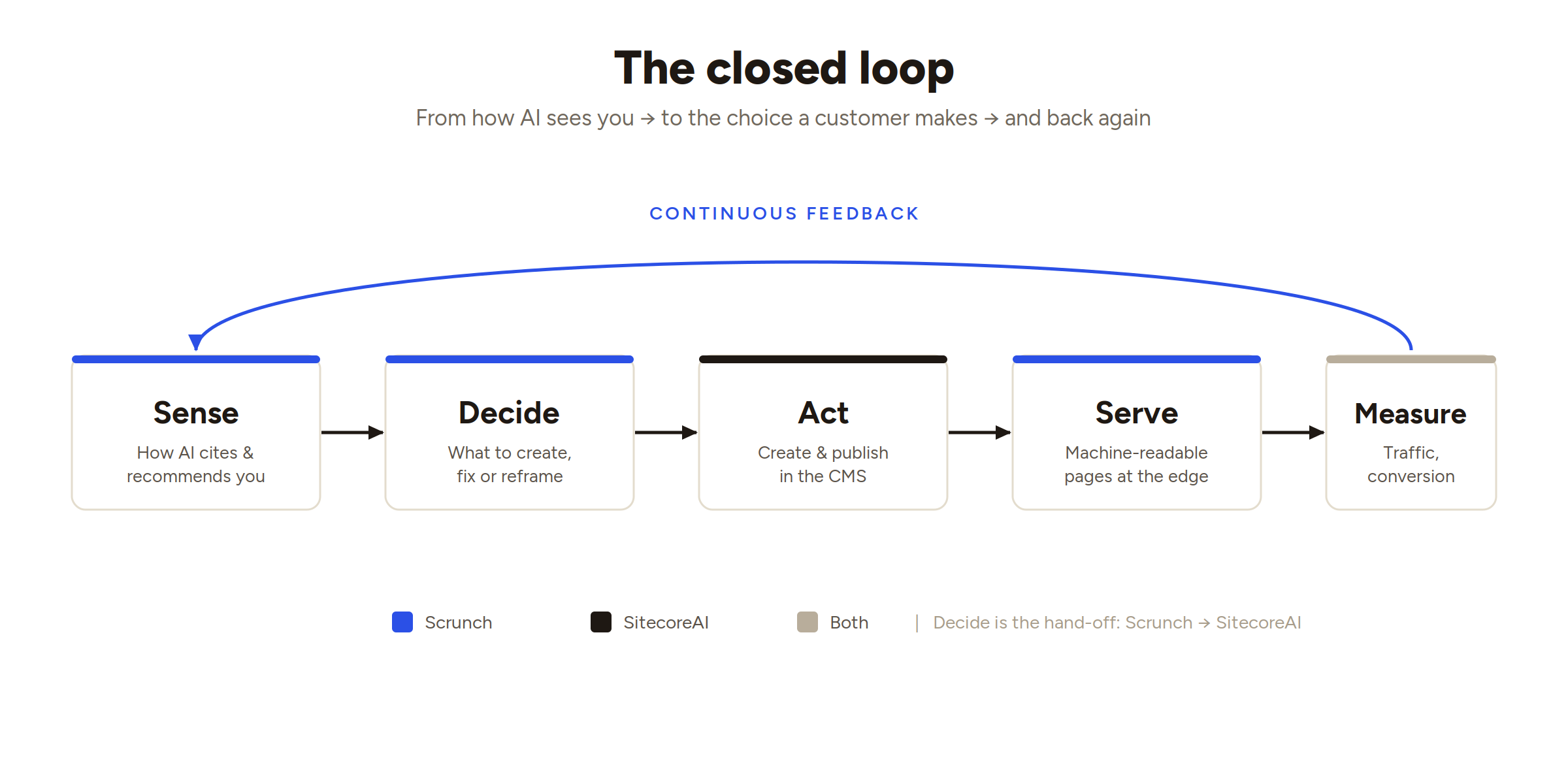
The combined offering claims to close that gap: from sensing how AI perceives you, to deciding what to change, to acting inside the content system, to serving agents machine-readable pages, to measuring the outcome—then back to the start. Scrunch's recommendations are slated to flow directly into SitecoreAI's content management, content marketing, and digital asset management workflows, so an insight can become a published fix without leaving the platform.
05 — The contextWhere this fits the SitecoreAI stack
To read the fit correctly, you need a detail that's easy to miss: Sitecore re-platformed itself only months earlier. In November 2025 it launched SitecoreAI, folding its formerly separate products—the CMS, Search, Personalize, the customer data platform, digital asset management, and more—into a single, AI-first system with one data model and an agentic studio of prebuilt automations. The portfolio sprawl people remember was already consolidated.
So Scrunch does not land in a maze of point tools. It lands on a unified stack as a new sensing-and-serving layer at the front of the funnel. Existing products aren't being retired because of it: Sitecore Search remains the on-site search module—adjacent to, not the same as, Scrunch's job of shaping how external AI engines represent you. Personalization, customer data, and content operations continue as capabilities within the same platform.
06 — The proofWhat early customers report
Sitecore is leaning on a handful of customer results to make the case. They are vendor-reported, so read them as direction rather than gospel—but the direction is striking.
07 — The divideWinners, losers, and the two camps
The technology will sort buyers into two groups. The first treats Scrunch as a dashboard—something to glance at monthly, nod gravely, and ignore. The second operationalizes the loop: a recurring cadence where content, brand, and web teams act on AI insights as routine work. The difference between them won't be the tool. It will be organizational.
08 — The boardThe competitive picture
Sitecore is not alone. Standalone AEO startups are multiplying, rival experience and content platforms will answer with their own moves, and the genuine wildcard is the LLM platforms themselves, which could absorb parts of this layer directly. The defensible position Sitecore is betting on is the closed loop—owning the content system is what a pure-play visibility tool cannot replicate. Whether that moat holds is the open question of the next year.
09 — The caveatsRisks worth tracking
Sober notes before anyone reallocates a budget: how Scrunch's capabilities get packaged and priced within SitecoreAI's consumption model is still unfolding; integration depth beyond the first content and asset-management hooks is stated intent, not yet a shipped, generally available feature set; the AEO category has low switching costs today; and edge-level agent detection raises governance and data questions. The slower-moving legacy install base will feel all of this last.
10 — The playbookWhat to actually do
If you're a brand: baseline how often AI engines cite and recommend you for your highest-intent queries, prioritize your content estate for machine-readability, and stand up a standing sense–decide–act cadence rather than a one-off audit. If you're an agency: AEO strategy and execution is a defensible new retainer line, not a free add-on. If you're a buyer evaluating the platform: hold it to outcome metrics—citation lift, share of answer, and conversion from AI-referred traffic—not feature lists.
Key takeaways for businesses
The skim-and-leave version
- The decision moves upstream. Buyers increasingly choose inside the AI answer, before any click. Win there or lose invisibly.
- Your website now has two audiences. Humans for the experience, AI agents for machine-readable content. Serve both, or AI will omit or misrepresent you.
- Visibility is not value. Dashboards tell you that you're losing; only a path from insight to published fix changes the result.
- Quantify your share of answer. Baseline how often AI cites and recommends you for high-intent queries. That is the new top-of-funnel KPI.
- Operationalize, don't accumulate. Winners run a weekly sense–decide–act loop; losers buy a tool and check it monthly.
- Stay portable. AEO is young and consolidating—build capability and process you can carry across vendors.
ConclusionVisibility is the floor; action is the game
Showing up in AI answers is fast becoming table stakes. The advantage—the part competitors can't copy by buying the same dashboard—is influencing what those answers actually say, then doing it again next week. Sitecore's bet is that the brands which connect discovery to action inside one system will own the answer when it counts. Over the next twelve months, AEO will stop being an experiment and start being a standard line on the marketing org chart. The only real question is whether you'll be writing those answers, or reading someone else's.
Sources: Sitecore press release (June 3, 2026); Scrunch announcement and product pages; Sitecore AI-search platform materials; Bloomberg and trade coverage; SitecoreAI launch materials (November 2025). Deal value (~$225M) per Bloomberg; financial terms were not officially disclosed. Performance figures are Sitecore/Scrunch-reported customer results and should be read as directional.