Understand How AI Concepts Fit Into the CMS Ecosystem
Artificial Intelligence (AI) is everywhere—from voice assistants and recommendation systems to self-driving cars and creative tools that write or draw. But the terms around AI can feel confusing. Let’s break them down in simple language.
1. What is AI (Artificial Intelligence)?
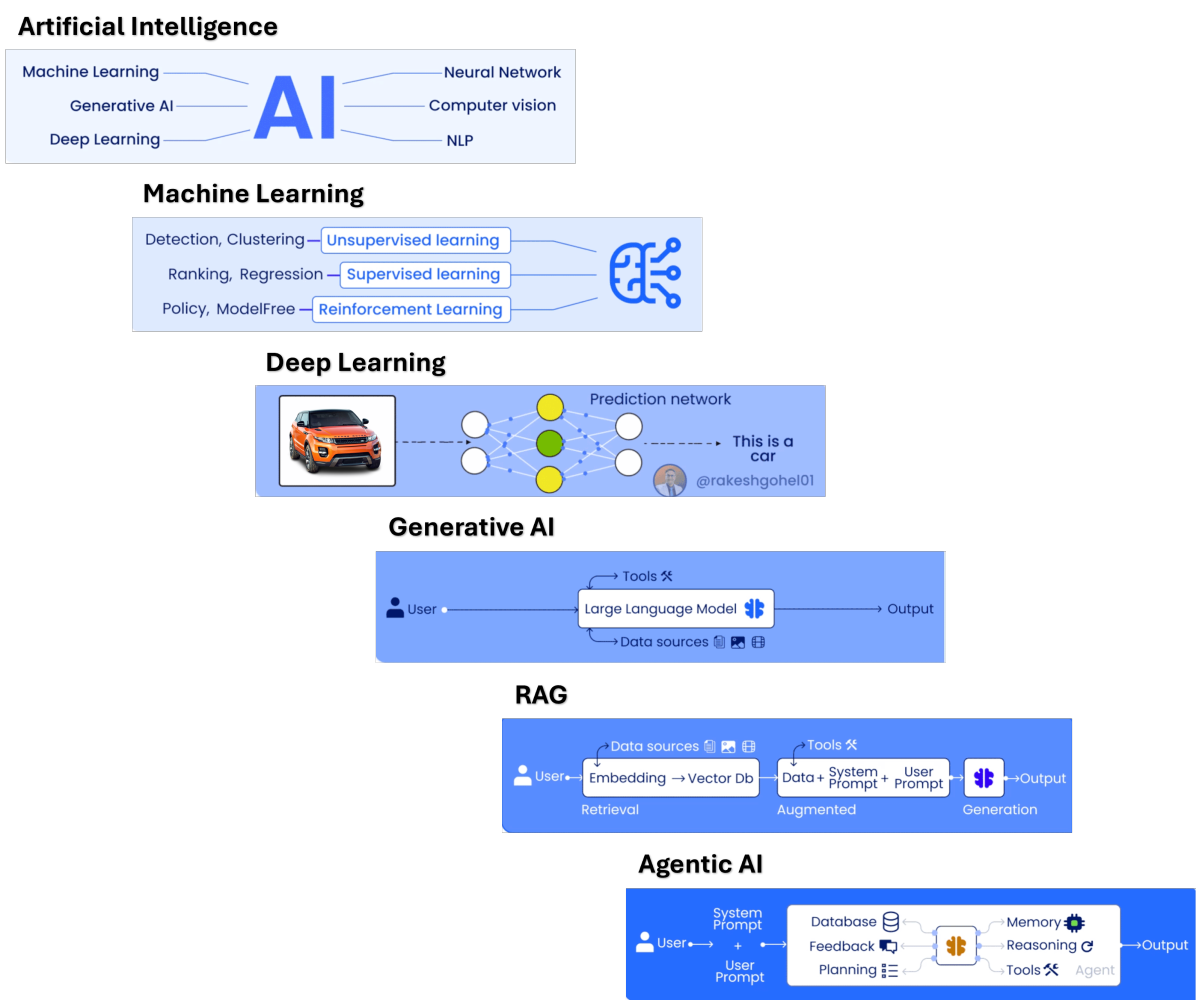
AI is the broad field of creating machines or software that can perform tasks that normally require human intelligence. These tasks include understanding language, recognizing images, making decisions, and even generating creative content.
Think of AI as the “umbrella” under which all other terms—like Machine Learning and Deep Learning—fit.
Examples:
- Siri or Alexa understanding your voice.
- Netflix recommending what movie you’ll like.
- A car recognizing a stop sign.
2. What is Machine Learning (ML)?
Machine Learning is a way of building AI systems that learn from data instead of being explicitly programmed. Instead of telling a computer how to solve a problem step-by-step, you give it lots of examples and it figures out patterns.
Types of learning:
- Supervised Learning → The model learns from labeled examples (e.g., showing many photos of cars vs. bikes).
- Unsupervised Learning → The model finds patterns on its own (e.g., grouping customers with similar buying habits).
- Reinforcement Learning → The model learns by trial and error, like teaching a robot to walk.
3. What is Deep Learning?
Deep Learning is a special kind of Machine Learning that uses neural networks inspired by the human brain. These networks are especially good at handling complex data like images, video, or speech.
How it works:
- An image of a car goes through many layers of a neural network.
- Each layer extracts features (wheels, windows, shape).
- The final layer predicts: “This is a car.”
This is why Deep Learning powers things like image recognition, translation apps, and self-driving technology.
4. What is Generative AI?
Generative AI is a branch of AI that creates new content instead of just analyzing data. It can generate text, images, audio, and even video.
Examples:
- ChatGPT writing an essay or answering questions.
- DALL·E creating an image from a text description.
- Tools that compose music or design 3D objects.
Generative AI uses Large Language Models (LLMs) or similar architectures trained on massive amounts of data.
5. What is RAG (Retrieval-Augmented Generation)?
Large Language Models like ChatGPT are powerful, but they don’t automatically know up-to-date or private information. That’s where RAG (Retrieval-Augmented Generation) comes in.
RAG combines two steps:
- Retrieval → The system searches a knowledge base or database to fetch relevant information.
- Generation → The AI uses that information to generate a precise, context-aware answer.
Example:
- Without RAG → An AI may not know your company’s latest policies.
- With RAG → It retrieves them from your internal documents, then answers your question accurately.
This makes RAG especially useful in business chatbots, customer support, and research tools.
6. What are AI Agents?
An AI Agent is more than just a chatbot. It’s an intelligent system that can reason, plan, and take actions using tools—not just answer questions.
How it works:
- You give a goal → “Book me the cheapest flight to New York tomorrow.”
- The AI Agent:
Key components:
- Reasoning → Decides how to approach the task.
- Memory → Remembers context and past interactions.
- Tools/Actions → Uses external systems like a calendar, search engine, or payment API.
This is where the future of AI is headed: not just answering but doing.
In Summary
- AI → The overall field of making machines smart.
- Machine Learning → Teaching machines to learn from data.
- Deep Learning → Using neural networks for complex tasks like vision and speech.
- Generative AI → Creating new content such as text and images.
- RAG → Combining retrieval of real data with AI’s ability to generate answers.
- AI Agents → Intelligent assistants that can plan, reason, and act on tasks.
Together, these technologies are shaping the digital world—from the apps we use daily to the future of work and creativity.
How AI Concepts Fit Into the CMS Ecosystem
While the core ideas of AI, Machine Learning, Deep Learning, Generative AI, RAG, and AI Agents apply broadly, they bring specific advantages when integrated into a CMS. Modern CMS platforms like Sitecore XM Cloud, Adobe Experience Manager, Optimizely, and others are already embedding these capabilities to make digital operations more intelligent, efficient, and scalable.
1. AI (Artificial Intelligence) in CMS
AI serves as the umbrella for embedding intelligence into digital experiences. Within a CMS, AI can:
- Personalize content delivery by analyzing user behavior.
- Automate content tagging and classification for easier content discovery.
- Optimize content workflows by predicting publishing schedules or best-performing channels.
Example: A CMS automatically suggests the right blog posts, videos, or product recommendations based on the visitor’s journey.
2. Machine Learning in CMS
Machine Learning helps CMS platforms learn from historical data to improve decision-making.
- Content recommendations → Suggest the right content to the right audience.
- User segmentation → Cluster users into groups based on browsing and buying behaviors.
- Content performance analysis → Predict which content formats (video, blogs, infographics) will perform best with certain audiences.
Example: An ML-driven CMS predicts which landing page design will convert higher, reducing A/B testing cycles.
3. Deep Learning in CMS
Deep Learning enhances media-heavy and language-rich CMS operations.
- Image and video recognition → Automatically tag assets in DAM (Digital Asset Management) with objects, people, or brand logos.
- Voice-to-text and translation → Convert webinars, podcasts, or videos into multilingual transcripts.
- Advanced search → Enable users to find content by describing it (“find the image with a red car in a showroom”).
Example: In Sitecore Content Hub DAM, deep learning can auto-tag uploaded images and classify them by product, season, or campaign.
4. Generative AI in CMS
Generative AI supercharges content creation and localization.
- Automated content drafting → Generate blogs, product descriptions, or marketing copy.
- Content reformatting → Turn a long whitepaper into bite-sized social media posts.
- Multilingual support → Translate and localize content at scale with contextual awareness.
Example: Marketing teams can generate SEO-friendly product copy directly within the CMS, reducing time-to-market.
5. RAG (Retrieval-Augmented Generation) in CMS
RAG ensures content generation is grounded in your organization’s real data, not just general AI knowledge.
- Policy-aware content → Ensure AI-generated FAQs, blogs, or chatbot responses pull from the company’s approved documents.
- Content reuse → Retrieve existing assets from a knowledge base and enrich them with AI.
- Internal search optimization → Give authors accurate answers from style guides, taxonomy rules, or compliance guidelines inside the CMS.
Example: A CMS chatbot for authors answers: “What’s our approved tone of voice for product launches?” by retrieving the brand style guide and then explaining it in plain language.
6. AI Agents in CMS
AI Agents are the future of intelligent digital operations within CMS platforms.
- Content lifecycle automation → Plan, draft, translate, review, publish, and archive content autonomously.
- Omnichannel orchestration → Push tailored content to web, mobile, email, and social simultaneously.
- Workflow assistance → Handle repetitive tasks like metadata updates, compliance checks, or asset approvals.
- Proactive insights → Suggest campaign improvements, highlight underperforming assets, or identify SEO gaps.
Example: An AI Agent in a CMS could:
- Pull product details from PIM.
- Generate landing page copy.
- Ensure it follows SEO rules.
- Route it for compliance approval.
- Schedule publishing—all without human intervention.