How Deepseek’s R1 Delivers Comparable Performance at Just 1/27th the Cost
The AI landscape is rapidly evolving, with companies racing to develop the most powerful reasoning-based models. Deepseek has recently introduced R1, a next-generation AI model that demonstrates remarkable performance at a fraction of the cost of its competitors.
Here’s what makes R1 stand out:
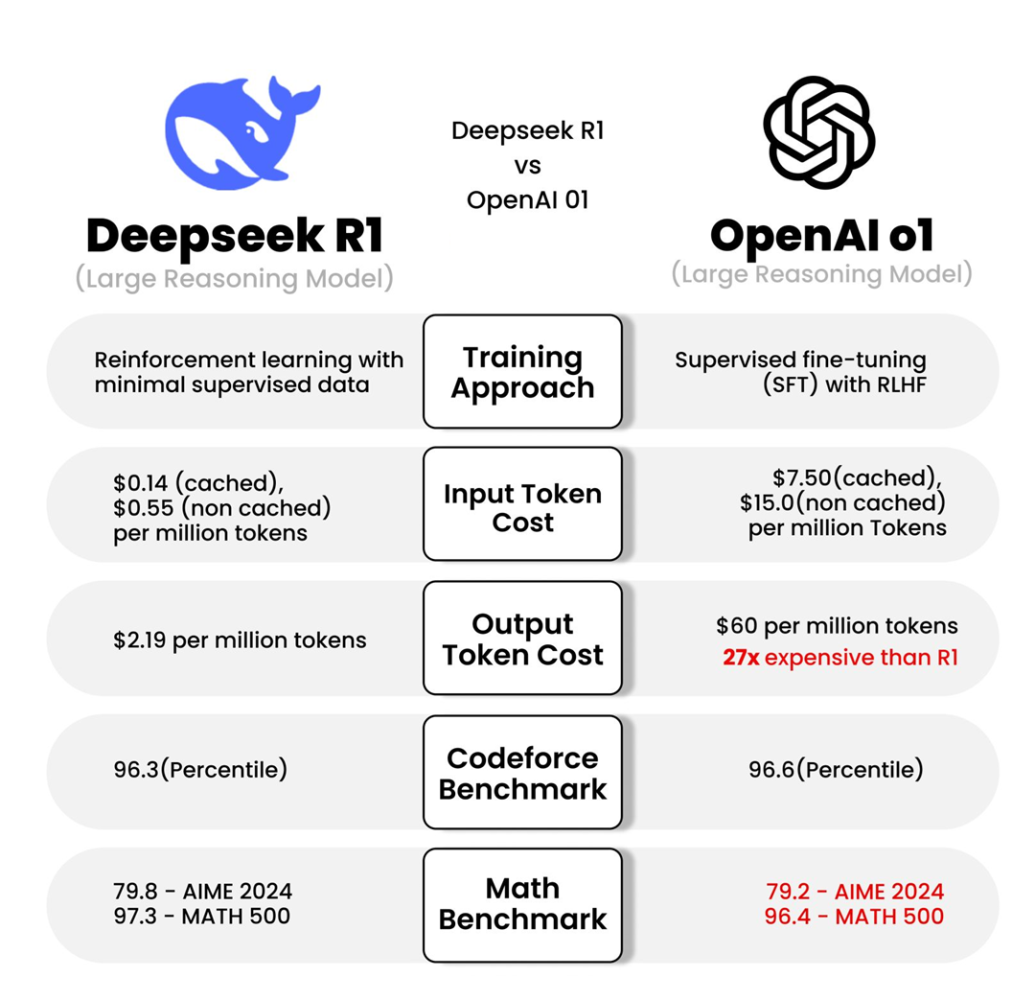
Model Architecture: The Power of Sparse Mixture of Experts (MoE)
Deepseek R1 leverages a Sparse Mixture of Experts (MoE) architecture combined with a reinforcement learning-first approach.
- Unlike traditional models that rely heavily on supervised learning, R1 focuses on self-improvement by learning from its own outputs.
- This is a similar methodology used in xAI’s Grok-1, which prioritizes reinforcement learning over dense training methods.
- In contrast, OpenAI’s o1 utilizes a blend of reinforcement learning and supervised fine-tuning, incorporating guidance from other high-performing models like GPT-4o.
Cost Advantage: 27x More Affordable Than OpenAI o1
One of R1’s biggest advantages is its cost-efficiency, making advanced reasoning models more accessible.
💰 Cost breakdown per million tokens:
- Input Token Pricing:
- Output Token Pricing:
This massive cost reduction positions R1 as a game-changer for companies looking to integrate advanced AI capabilities without breaking the bank.
Open-Source Advantage: R1’s Distillation Capability
Deepseek R1 is open-source, meaning developers can fine-tune and distill it into smaller, efficient models.
- Smaller versions of R1 (from 1.5B to 7B parameters) are already available via Ollama, allowing local deployment.
- On the other hand, OpenAI’s o1 does not currently support distillation, though smaller versions like o1-mini exist for optimized use cases.
This open-source flexibility makes R1 a strong candidate for customization and lightweight applications.
Optimized Prompting for Reasoning Models
R1’s research emphasizes the effectiveness of zero-shot prompting over few-shot learning for reasoning tasks.
- Key takeaway: When interacting with reasoning models, being direct and precise in prompts yields better results.
- This insight could help refine prompt engineering techniques across various LLMs.
Performance Benchmark: How Does R1 Compare to OpenAI o1?
R1 delivers competitive results in reasoning tasks, sometimes outperforming OpenAI’s o1.
🧠 Codeforces percentile:
- Deepseek R1: 96.3
- OpenAI o1: 96.6
📊 Math-based & software engineering reasoning:
- Deepseek R1:AIME 2024: 79.8MATH 500: 97.3
- OpenAI o1:AIME 2024: 79.2MATH 500: 96.4
These results indicate that while o1 holds an edge in some areas, R1 is extremely close in performance, especially in mathematical reasoning.
💡 The Future of Cost-Effective AI Models
With the recent emergence of models like Sky-T1—which delivered performance on par with o1 for just $450—it’s becoming evident that state-of-the-art AI no longer requires massive budgets.
Deepseek R1’s launch signals a shift in AI development, challenging OpenAI to make high-performance models more widely accessible. The growing presence of open-source alternatives like R1 could drive industry-wide changes, pushing AI companies to balance innovation, cost-efficiency, and openness.
🧠 Sources:
https://github.com/deepseek-ai/DeepSeek-R1/blob/main/DeepSeek_R1.pdf
https://cdn.openai.com/o1-system-card-20241205.pdf
What’s Your Take?
Do you think Deepseek R1 can rival OpenAI o1 in real-world applications?
💬 Drop your thoughts in the comments!
🔁 Share this with AI enthusiasts
👍 React if you find this insightful
📌 Save for later insights
Follow for more updates on AI and reasoning models! 🚀