AI Agents are the next step in artificial intelligence — not just answering questions, but reasoning, planning, and taking actions. To truly understand them, it helps to break down the core concepts. Here are 20 key terms every beginner should know:
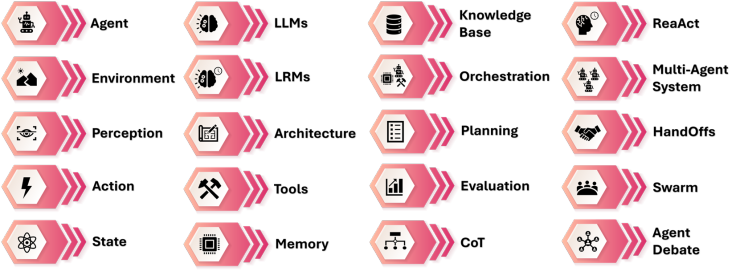
1. Agent
An Agent is an AI entity that uses prompts and its environment to perceive, reason, and act toward achieving goals. Think of it as the "worker" that gets things done.
2. Environment
The Environment is the context or sandbox where an AI Agent operates. It’s where the agent interacts with users, data, and external tools.
3. Perception
Perception is the Agent’s ability to interpret information from the environment — like reading a document, recognizing speech, or analyzing sensor data.
4. Action
Action refers to the tasks an AI Agent performs after reasoning — like sending an email, retrieving data, or triggering an API call.
5. State
The State represents the current condition of the Agent’s environment or system. It’s the snapshot of “what’s going on right now.”
6. LLMs (Large Language Models)
These are the brains behind most AI Agents. LLMs like GPT can understand language, generate text, and reason based on context.
7. LRMs (Large Reasoning Models)
Unlike LLMs that focus on text, LRMs emphasize reasoning — breaking problems into logical steps for better decision-making.
8. Tools
Agents often need Tools (APIs, databases, apps) to perform tasks beyond language — for example, querying a CRM, running a script, or checking a calendar.
9. Memory
Memory allows Agents to store past interactions and current context so they can learn, adapt, and maintain continuity across conversations.
10. Knowledge Base
A Knowledge Base is a structured database of facts and content. Agents retrieve knowledge from here to ground their responses in real information.
11. Orchestration
Orchestration is the process of coordinating how agents interact with tools, data, and each other to achieve a goal. It’s like a conductor leading an orchestra.
12. Planning
Planning means defining a sequence of steps the Agent must take to complete a task — similar to a project plan but executed in real time.
13. Evaluation
This is how we measure how well an Agent achieves its goals. Evaluation helps refine performance, accuracy, and reliability.
14. Architecture
The Architecture is the blueprint of an AI Agent — defining how its components (memory, reasoning, planning, tools) interact to form a working system.
15. CoT (Chain of Thought)
Chain of Thought is a reasoning technique where the Agent breaks down complex problems step by step, instead of jumping to answers.
16. ReAct
ReAct (Reason + Act) is a framework where the Agent reasons and acts in cycles. It thinks through a step, acts, re-evaluates, and continues iteratively.
17. Multi-Agent System
A Multi-Agent System is when multiple agents collaborate in a shared environment, each contributing their strengths to solve bigger problems.
18. Swarm
Swarm Intelligence emerges when agents collectively exhibit intelligent behavior through decentralized, self-organized interactions — inspired by nature (like ants or bees).
19. Handoffs
Handoffs occur when one Agent passes a task to another Agent that’s better suited for it — ensuring efficient collaboration.
20. Agent Debate
This is when multiple Agents engage in structured argumentation, comparing perspectives, and debating solutions to produce more accurate and balanced outcomes.
Why These Terms Matter
These 20 terms explain the building blocks of AI Agents — from the environment they work in, to the tools they use, to the ways they plan, collaborate, and improve.
In the future, AI Agents won’t just answer questions — they’ll:
- Run marketing campaigns end-to-end.
- Manage content workflows inside a CMS.
- Automate research and decision-making.
- Collaborate like digital coworkers.
Understanding these fundamentals will help teams unlock the power of intelligent, autonomous systems in business and digital operations.