The strongest message from the first main conference day of Sitecore Symposium 2026 was not that marketing needs more AI-generated content. It was that brands need a better way to connect what AI is saying about them with what marketing teams can actually change.
Under the event's “Marketing Rewired” theme, Sitecore introduced MarketingIQ, showed how its Scrunch capabilities can identify gaps in AI-driven discovery, and outlined a pragmatic route for organizations still operating Sitecore XM or XP. The broader story was as much about adoption, existing investments and governance as it was about new technology.
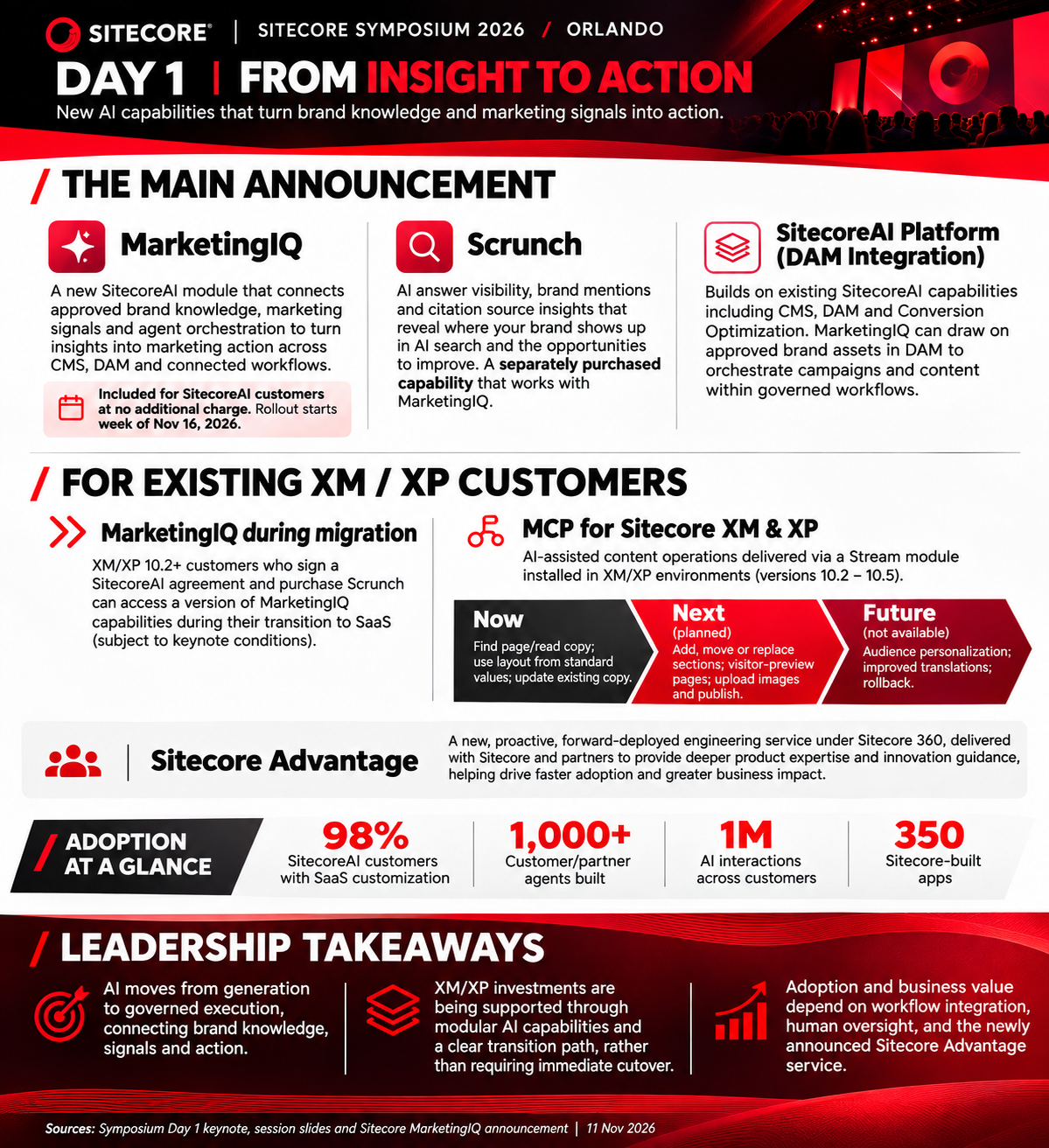
MarketingIQ: connecting signals, brand knowledge and execution
MarketingIQ is a new module within SitecoreAI designed to connect market signals with the business context required to act on them. It combines approved brand and product information, existing content, performance data and agent orchestration so that an identified opportunity can progress into a proposed—and ultimately approved—marketing change.
This is an important distinction. MarketingIQ is not a replacement for the CMS, DAM, analytics or other systems already responsible for particular tasks. Its role is to coordinate the work across them, helping people and agents move from a goal or a discovered problem to content, review, publication and measurement.
Sitecore said MarketingIQ would be available to SitecoreAI customers, with no additional charge for the module, and indicated rollout beginning the week of November 16, 2026. Its current product information also clarifies that an XM/XP license alone does not include MarketingIQ; organizations need the applicable SitecoreAI entitlement and configured access.
Sitecore is also designing this workflow to reach beyond its own interface. Supported integrations can allow marketers to work from compatible assistants, including Claude and ChatGPT, once connections, permissions and approvals have been configured. That should not be interpreted as universal, out-of-the-box compatibility with every existing AI subscription.
Why Scrunch matters to the MarketingIQ story
Traditional search performance tells only part of the discovery story. Buyers increasingly receive recommendations, product comparisons and brand descriptions directly from AI assistants—sometimes without visiting a brand's website. Scrunch helps organizations see how they appear in those answers, what sources are cited, and where information may be missing or inaccurate.
MarketingIQ and Scrunch do different jobs: Scrunch surfaces the AI-discoverability signal; MarketingIQ relates it to approved business knowledge, identifies potential responses and coordinates the marketing work. Scrunch is a separately purchased capability, not an automatic part of MarketingIQ's no-additional-charge inclusion.
For an enterprise, the practical opportunity is to connect an issue in an AI-generated answer to a traceable change in an authoritative content source—not simply to produce more material and hope the answer improves.
SitecoreAI DAM: trusted assets remain central to the story
Digital asset management featured prominently in the broader SitecoreAI narrative, but it is important not to confuse product evolution with a new launch. SitecoreAI DAM is the evolution of Sitecore Content Hub DAM within the SitecoreAI portfolio. Sitecore says existing Content Hub DAM customers retain their assets and workflows as the product evolves.
The strategic relevance is straightforward: autonomous or agent-assisted marketing depends on reliable source material. A governed DAM can provide approved imagery and documents, rights and expiration information, metadata, versions, localization support and API-based access. MarketingIQ can use those approved assets in coordinated workflows; Scrunch Knowledge Studio connects governed brand material to AI-discoverability use cases.
Sitecore also describes open APIs and integrations for use outside its own platform. However, SitecoreAI DAM should not be presented as an announced automatic replacement for the traditional XM/XP Media Library. Those are different architectural considerations, and any migration decision requires a separate assessment.
XM and XP customers are part of the AI roadmap
A meaningful part of the keynote was directed at customers with years of investment in Sitecore XM and XP. Rather than framing the move to SaaS as the only way to begin using new AI capabilities, Sitecore described a bridge for qualifying customers on XM/XP 10.2 and later who have signed a SitecoreAI agreement and purchased Scrunch. The keynote positioned a version of MarketingIQ capabilities for use during their SaaS migration, subject to the stated commercial and migration conditions.
Separately, a product session presented MCP for Sitecore XM and XP, with AI-assisted content operations delivered through a Stream module installed in an existing environment. The in-room slides identified versions 10.2 through 10.5 and distinguished the initial release scope from subsequent plans.
Find a page and read its copy; use the layout from standard values; update existing page copy.
Add, move or replace sections; preview the visitor-facing page; upload images and publish.
Audience personalization; improved page translation; rollback of changes.
The phases above reproduce the status distinctions visible in the November 11 session slides. “Next” and “Future” are roadmap statements, not currently delivered functionality. The session material does not by itself settle every hosting, licensing or Stream-edition scenario.
These are two related but distinct propositions: MarketingIQ during migration addresses access to marketing intelligence and orchestration, while XM/XP MCP exposes a phased set of agent-assisted content operations inside existing installations. They should not be treated as the same product feature.
Sitecore Advantage puts adoption on the agenda
Sitecore also introduced Sitecore Advantage, described in the keynote as a more proactive, forward-deployed engineering and advisory model within Sitecore 360. The objective is to help customers identify underused capabilities, connect them to real workflows and get more value from what they already own.
Sitecore was explicit that this model is meant to work alongside implementation and agency partners, not replace them. It is a recognition that shipping more features is not the same as helping enterprises adopt them.
The keynote reinforced this point with adoption figures for products introduced previously—not new Day 1 launches. Customizable SaaS, Agent Studio and marketplace/custom apps were presented as evidence that the platform's earlier investments are being used.
Figures are as reported in the keynote and should be read as vendor-reported adoption indicators rather than independent measures of business impact.
Three leadership takeaways from Day 1
- AI value increasingly depends on execution, not generation. The competitive advantage is connecting signals and approved knowledge to changes that can be governed, published and measured.
- Modernization can be progressive. Sitecore's XM/XP message acknowledges established platforms and offers ways to introduce AI capabilities while a longer-term SaaS transition is considered or underway.
- Governance and adoption are architectural concerns. Asset rights, brand context, approvals, integration patterns and accountable teams determine whether agent-assisted workflows are practical at enterprise scale.
There is an important balance in this year's story. Sitecore is articulating a more connected marketing operating model, but the value of that model will be proven in production workflows: the quality of the business context, what assistants are actually authorized to do, the efficiency of review and publication, and measurable improvements in customer outcomes.
The Day 1 conclusion: Sitecore's direction is moving from a collection of digital experience capabilities toward a coordinated system for discovering opportunities and executing governed marketing work. MarketingIQ is the clearest new expression of that direction; Scrunch, DAM, XM/XP tooling and Sitecore Advantage show how Sitecore intends to make it useful across different starting points.
References
This article reflects first-hand notes from the November 11, 2026 keynote and product slides, supplemented with Sitecore's public descriptions. Product terms, licensing and future availability should always be confirmed against current Sitecore documentation and commercial agreements.