Sitecore Symposium Day 2 connected two ideas that, taken together, could reshape how enterprise websites are designed. Tim Sanders of G2 framed the first challenge: AI is becoming a gatekeeper in the buyer journey, so the objective is no longer just to be found — it is to be chosen. The Scrunch keynote then pushed the idea further: if AI agents are increasingly researching, validating and even acting on behalf of humans, the web itself has to become easier for agents to understand and use.
AI is compressing the buyer journey
Traditional digital journeys assume a human moves across search results, analyst reports, review sites, vendor pages and peer recommendations before building a shortlist. Sanders argued that this is rapidly changing. A buyer can now describe a job-to-be-done, constraints, success criteria and procurement rules in a single prompt — and receive a shortlist immediately.
This model is best treated as a strategic framework rather than a literal description of a single universal ChatGPT algorithm. But the marketing implication is strong: a brand can be visible in AI answers and still fail to be recommended.
Keywords are too small for the new buyer intent
One of the keynote's most useful examples compared a short-tail search such as “best CRM for hospitals” with a long-form AI prompt that included affordability, patient scheduling, messaging, reimbursement processing, mobile support and contract-length constraints.
That difference matters because the AI system is not simply matching a category label. It is attempting to satisfy a specification. If a brand's content does not clearly describe the capabilities, constraints, commercial terms and use cases relevant to that specification, it may never make the candidate set.
Jobs to be done
What is the buyer actually trying to accomplish?
Constraints
Budget, compliance, timing, procurement rules, tooling and risk.
Success criteria
What does “good enough” or “best fit” mean for this buyer?
The practical lesson is to build prompt models from real customer language — sales calls, RFPs, reviews, customer interviews and captured buyer prompts — rather than simply transforming SEO keywords into longer questions.
Being cited is not the same as being recommended
Sanders repeatedly separated visibility from recommendation. A brand mention can create awareness. A citation can establish a source relationship. A link may generate traffic. But for commercial-intent queries, the highest-value outcome is being included in the recommended shortlist.
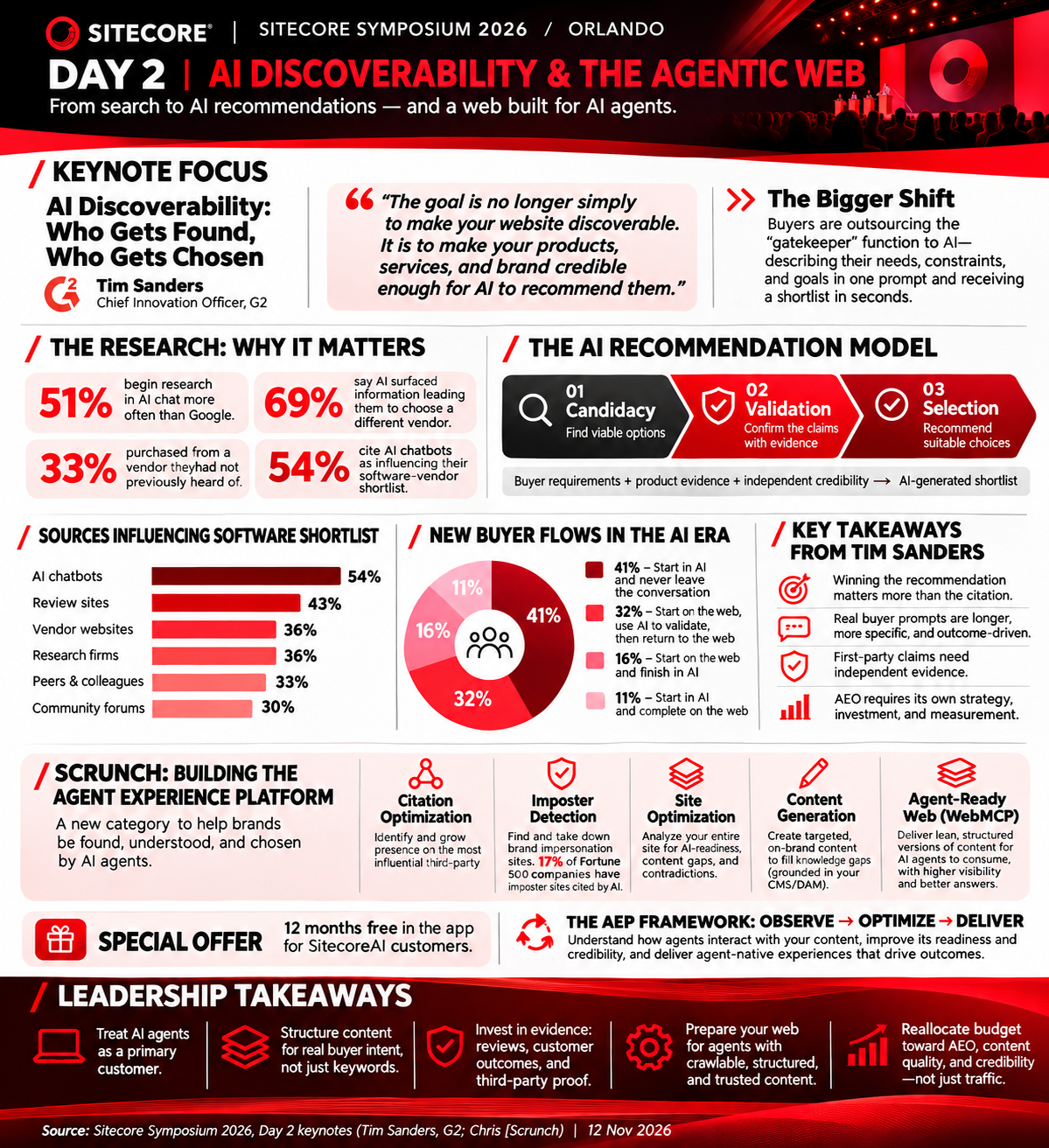
Sources influencing software shortlists
The deeper point is not the exact number. It is the change in what content must prove. If your site says you are fast, secure, global or easy to implement, AI systems can increasingly seek evidence elsewhere to validate those claims. Reviews, analyst coverage, awards, case studies, customer examples and credible third-party mentions therefore become part of the product story — not just the PR story.
The web was not built for agents
The Scrunch keynote extended the argument from AI recommendation to agent-driven outcomes. The core thesis was simple: people are increasingly delegating research, comparison and execution to agents. Those agents may browse websites, inspect product information, compare alternatives, validate fit and ultimately complete an action on the user's behalf.
The next version of the web will not be designed only for human browsing. It will also need to serve agents that consume information, evaluate choices and drive outcomes.
The keynote illustrated this with everyday examples: finding an out-of-print book, buying event tickets, researching services, comparing providers and evaluating wealth-management options. The common thread was not “AI search” in the narrow sense. It was intent delegation: the user described an outcome, and an agent did the work.
New buyer flows in the AI era
Start in AI and never leave the conversation.
Start on the web, use AI to validate, then return to the web.
Start on the web and finish in AI.
Start in AI and complete the outcome on the web.
Observe → Optimize → Deliver
Scrunch positioned its product direction around an Agent Experience Platform — a layer designed to help brands understand how AI agents interact with their content, improve the signals those agents consume, and ultimately deliver experiences that are easier for agents to use.
See what agents see
Understand AI visibility, brand interpretation, citations, misinformation and how agents retrieve information from the web.
Fix gaps and contradictions
Improve technical accessibility, structure, content consistency, source coverage and evidence.
Create agent-ready experiences
Expose clean, efficient, structured information that helps agents complete tasks with less ambiguity.
Citation Optimization
Identify influential third-party sources and gaps in external presence.
Imposter Detection
Find domains that imitate or misrepresent the brand and may be surfaced by AI.
Site Optimization
Scan large sites for AI-readiness, contradictions, gaps and content conflicts.
Grounded Content Generation
Create targeted content from governed CMS/DAM knowledge rather than flooding the web with generic AI copy.
Agent-Ready Web
Deliver lean, structured experiences intended specifically for AI-agent consumption.
One especially important message was the warning against indiscriminate AI content generation. The keynote argued for targeted, governed content creation grounded in the brand's approved knowledge, CMS and DAM — not thousands of low-value pages generated simply to attract model activity.
Why this matters for SitecoreAI
The strategic value becomes clearer when the Day 2 story is viewed together with the Day 1 SitecoreAI announcements. MarketingIQ, Scrunch, CMS, DAM and governed brand knowledge are converging around a common problem: how to turn trusted enterprise content into signals and experiences that work across both human and AI-mediated journeys.
Day 2 adds the external interface: how that intelligence becomes discoverable, trusted and actionable by AI systems outside the enterprise.
The Scrunch keynote also announced 12 months free in the app for SitecoreAI customers, reinforcing the intention to make AI visibility and agent-readiness a practical part of the SitecoreAI proposition rather than a disconnected analytics add-on.
Five leadership priorities to act on now
For Sitecore and composable architectures
This has direct implications for content modeling, taxonomy, search, DAM, localization and headless delivery. A composable stack should not merely make content reusable across channels; it should make the relationships between services, locations, expertise, audiences, proof points and outcomes explicit enough for AI systems to evaluate them.
In that context, XM Cloud, Next.js, Sitecore Search, taxonomy, DAM and translation become more than implementation choices. Together, they can form the information architecture that helps AI systems understand what the enterprise actually does, where it does it, for whom, and with what evidence.
The next competitive edge is recommendation readiness
SEO is not disappearing. Websites are not disappearing. Human digital experiences are not disappearing. But a new intermediary is entering the journey: AI systems that summarize, compare, validate, recommend and increasingly act.
That changes the standard for digital excellence. The winning brand will not simply rank well or publish more content. It will be the brand whose content is structured clearly, supported by evidence, aligned to real buyer intent, easy for agents to retrieve, and trustworthy enough to recommend.
From search optimization to recommendation readiness: the answer economy will reward brands that combine structured content, credible proof and agent-ready delivery with a digital experience that still works beautifully for humans.
Digital experience is becoming a two-audience discipline
The executive takeaway
Day 2 of Sitecore Symposium 2026 moved the discussion beyond AI as a content-generation tool. The more consequential shift is that AI is becoming an intermediary in discovery, evaluation and action. Enterprises now have to serve two audiences at the same time: the human who ultimately owns the decision, and the AI agent increasingly helping that human make it.
For digital leaders, this changes where competitive advantage is built. Content architecture, taxonomy, DAM governance, technical accessibility, third-party evidence and product truth are no longer separate optimization exercises. Together they determine whether an AI system can understand a brand, trust its claims, include it in a shortlist and confidently act on its information.
The strategic response should not be to abandon SEO or redesign every experience for bots. It should be to extend the digital operating model: preserve rich human experiences while creating a structured, governed and evidence-rich layer that agents can consume efficiently. That is where Sitecore's CMS, DAM, search, orchestration and Scrunch capabilities begin to form a much more connected story.