Field notes from years of shipping multisite roll-outs at global scale
Across the last decade I’ve shepherded dozens of multisite programmes for retailers, manufacturers, universities, and B2B giants. The pattern is always the same: marketing dreams big, IT tries to keep up, and somebody starts the stopwatch. A “simple” product-launch microsite could chew through a whole quarter. By the time it finally shipped, search trends had dipped and the merch team was scrambling to unload excess stock.
That cycle finally snapped when we switched to a multisite-first architecture—shared templates, automated DevOps, and a component library that travels from one brand or region to the next. I’ve since repeated (and refined) that model on programmes ranging from five to 500 sites. The outcome is no longer theory; it’s muscle memory.
The Playbook That Turns Quarters into Weeks
Note: The specifics—tooling, sprint cadence, legal gates—differ by client. The principles never do.
1. Tenant-First Information Architecture
- Every brand, business unit, or regional site sits in its own “tenant,” inheriting core templates, design tokens, and security roles.
- Spin up a fresh tenant and you’re 70-80 % done at the moment of creation.
- Field takeaway: Once governance lives in the blueprint, you stop handwriting policy decks and start letting the platform do the enforcing.
2. Reusable Component Library
- Think LEGO®, not bespoke HTML. We treat headers, hero banners, product cards, and CTA blocks as atomic assets with semantic versioning.
- Authors drag-and-drop; developers extend rather than copy/paste.
- Field takeaway: Fix a bug or add an enhancement once, and every live site inherits the change at deploy time. That single habit eliminates entire categories of regression work.
3. Centralised Content & Asset Hub
- A single DAM feeds every channel: web, mobile, social, POS kiosks.
- Translation memory plugs straight into the workflow, so localisation is a scheduled event, not an emergency.
- Field takeaway: When the asset truth is singular, the approval chain shortens automatically. Legal reviews happen once, not per site.
4. CI/CD on Autopilot
- Git commit → container build → automated tests → promote.
- Blue-green releases are the default; feature flags make incremental rollout a non-issue.
- Field takeaway: The conversation shifts from “when can we deploy?” to “which flag flips at noon?”
5. Elastic, Container-Based Hosting
- Docker everywhere; horizontal autoscaling for launch peaks; nightly scale-down for cost control.
- Field takeaway: Finance finally sees lower TCO instead of just faster speed—critical for long-term executive sponsorship.
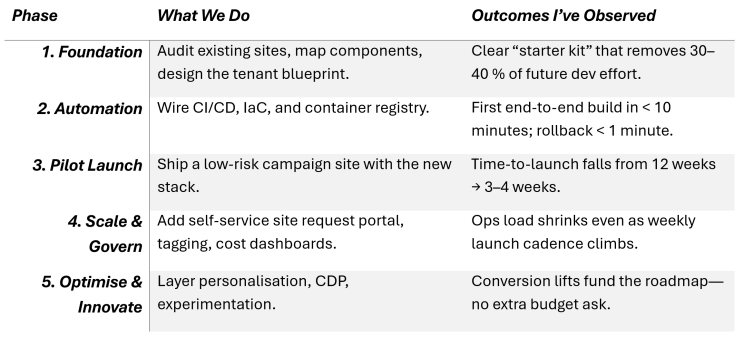
Rolling Out the Engine (A Repeatable Five-Phase Pattern)
Benchmarks From the Field (Directional, Not Absolute)
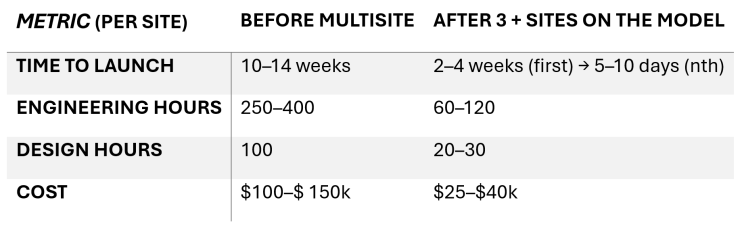
These are median ranges across six enterprise programmes I’ve led since 2018. Your mileage will vary, but the direction never did.
Ready to Reset Your Timeline?
If you’re still treating each microsite like a bespoke snowflake, you’re leaving time, budget, and competitive advantage on the table. A tenant-first architecture, a living component library, and automated DevOps aren’t “nice to have” anymore—they’re the new baseline for meeting market moments.
Curious how the model could fit your stack? I’m happy to share deeper war stories, templates, and governance checklists forged in the field. Because in 2025, speed to market isn’t just a KPI—it’s survival.