Sitecore’s journey from an all-in-one on-premises DXP to a fully composable, cloud-native suite has fundamentally reshaped how brands deliver digital experiences. XM Cloud, Personalize & CDP, Content Hub, and the new AI-powered Sitecore Stream equip organizations with unprecedented speed, scalability, and intelligence. Yet many enterprises still struggle to translate license costs into measurable performance gains. This post unpacks why—and offers a pragmatic blueprint for turning modern Sitecore capabilities into sustained business value.
Overview of Sitecore’s Evolution
- Monolith to Composable. Early Sitecore deployments bundled CMS, personalization, and analytics in a single install. Today, each function is available as SaaS micro-services that can be adopted à la carte and integrated with best-of-breed tools.
- Cloud-native Foundations. XM Cloud eliminates upgrade cycles, automates scaling, and pushes weekly feature releases—reducing technical overhead and opening the door to rapid experimentation.
- AI at the Core. Sitecore Stream, rolling out through 2025, embeds brand-aware generative AI copilots and orchestration workflows across the stack, collapsing campaign timelines and elevating content quality.
Shift in Expectations. Audiences now demand friction-free, personalized, omnichannel experiences—while CMOs expect marketing to pivot on a dime. Traditional “set-and-forget” DXPs rarely keep pace.
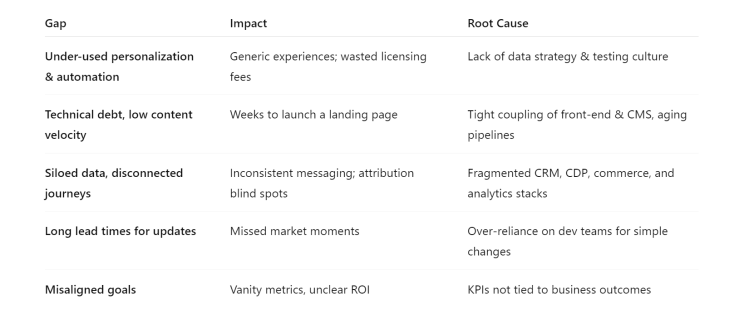
ROI Challenge. Licensing a modern platform is not the same as activating it. Without clear governance, data foundations, and marketer empowerment, advanced features remain shelf-ware and ROI stagnates.
Part 1: The Modern Context
- Age of Experience. Customer loyalty hinges on relevance and immediacy. McKinsey research shows brands that excel at personalization generate 40 % more revenue (average) than peers.
- Omnichannel Imperative. Users fluidly switch between mobile, web, social, and in-store; content must follow them in real time.
- Need for Agility. Campaign windows that once spanned months now unfold in days—or hours. Static site releases cannot compete.
Where legacy DXP deployments falter: monolithic upgrades, hard-coded components, siloed analytics, and change-request queues that frustrate marketers.
Part 2: Common Gaps in Value Realization
Part 3: Modern Sitecore Capabilities That Drive Value
1. Headless Architecture (XM Cloud)
- Speed & Scalability. SaaS hosting, autoscaling, and edge-rendered pages cut time-to-first-byte and handle traffic spikes effortlessly.
- Developer Agility. Next.js SDKs decouple code releases from content edits, enabling CI/CD pipelines and feature flags.
- Omnichannel Delivery. A single GraphQL endpoint pushes content to web, apps, kiosks, and IoT.
2. Personalization with CDP & XM Cloud
- Unified Profiles. Real-time behavioral and transactional data stitched into 360° profiles for 1:1 targeting.
- Experimentation at Scale. Marketers run A/B/n tests and rules-based personalization without redeploying code.
3. Content Hub & DAM Integration
- Reusable Assets. Modular content blocks reduce duplication and speed localization.
- Workflow Automation. Built-in approvals, rights management, and translation connectors streamline global rollouts.
4. Composable Stack
- Best-of-Breed Flexibility. Plug-and-play APIs let you combine Sitecore services with commerce (e.g., BigCommerce), search (e.g., Algolia), or AI chat (e.g., OpenAI).
- Future-Proofing. Swap components without re-platforming, lowering total cost of ownership.
5. AI-Powered Orchestration (Sitecore Stream)
- Intelligent Workflows. Auto-generate briefs, route tasks based on skill, and surface optimization recommendations.
- Co-pilot Productivity. Brand-aware generative AI suggests headlines, image variants, and even code snippets—freeing teams to focus on strategy.
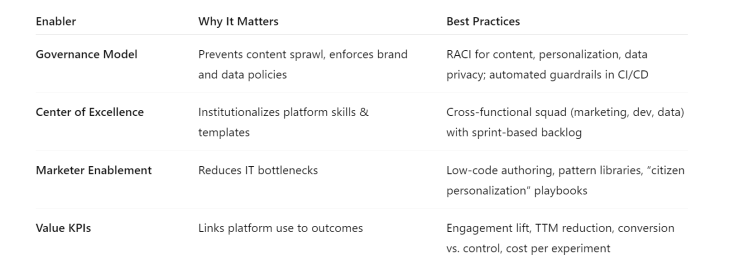
Part 5: Strategic Enablers for Realization
Conclusion
Sitecore’s power no longer resides in a monolithic “platform,” but in a composable constellation of cloud services and AI accelerators. The organizations that translate that power into performance share three traits:
- Strategic Alignment. Clear governance and KPIs that tie platform use to business growth.
- Composable Mindset. Decoupled architecture that evolves with the martech landscape.
- People Enablement. Empowered marketers and a CoE that continually drives best practice adoption.
Activate these pillars, and Sitecore stops being a line-item expense and starts compounding ROI—turning platform into true performance in the modern digital era.